Bedding · Nursery essentials
A Practical Guide to Organic Crib Mattress Pads: Fit, Fabric, and Care
A crib mattress pad is a quiet, hardworking layer: tucked beneath the fitted sheet, it helps shield the mattress from everyday mess while adding a considered textile surface to the nursery. Choosing one is less about grand promises than about getting the details right—dimensions, construction, materials, laundering, and, above all, a secure fit.
Organic crib mattress pads often appeal to parents who want to understand what touches a baby’s sleep space and how those materials are made. But the word “organic” is only one part of the decision. A pad also needs to suit the mattress, stay smooth beneath its sheet, and fit the household’s approach to routine care. Fabric and quilting affect its feel; a waterproof layer, when present, changes how it functions; and washing instructions determine whether it is practical for repeated use.
This guide breaks those considerations into manageable questions. It uses Naturepedic designs as examples of different constructions—not as a guarantee of safety, comfort, or sleep quality. Product details can change, so always check the current label and manufacturer instructions before use.
What a crib mattress pad does
A mattress pad sits between the crib mattress and the fitted sheet. Depending on its materials and construction, it may add a modestly cushioned surface, help protect the mattress from spills and body oils, or provide a barrier against moisture. Some pads are made primarily from quilted cotton; others include a waterproof membrane or a different kind of fill. These are distinct functions, and one product may not offer all of them.
It helps to distinguish a pad from a mattress protector, even though retailers and manufacturers sometimes use the terms in overlapping ways. A quilted pad typically emphasizes a soft or padded layer. A protector may prioritize shielding the mattress from liquids and everyday wear, with little added loft. A product can combine both roles, but the construction—not the name alone—explains what it is designed to do.
For a nursery, the most important starting point is compatibility with the mattress and the crib’s safe-sleep setup. Follow the crib and mattress manufacturers’ instructions, along with current guidance from recognized pediatric health and safety authorities. A pad should not change the intended fit of the sheet or create loose, bunched material. A comfortable-looking layer is not useful if it compromises a close, secure surface.
Begin with the mattress dimensions
Before comparing fabrics, identify the exact mattress size and depth. Standard crib mattresses are commonly around 28 by 52 inches, but dimensions and thickness can vary. Mini cribs, portable cribs, and specialty mattresses have different measurements. Even a small mismatch can make a fitted item difficult to secure or leave excess material at the corners.
Measure the mattress if its specifications are not readily available. Record its length, width, and depth, including any raised or contoured areas that affect how a fitted pad sits. Then compare those figures with the pad’s stated dimensions and pocket depth. Do not assume that a product labeled “crib size” will fit every crib mattress.
- Length and width: Confirm that the pad is intended for the mattress dimensions, not just a broad category.
- Depth: Check the manufacturer’s stated maximum mattress thickness or fitted-pocket depth.
- Construction: Consider whether quilting or a waterproof backing adds thickness that affects the fit.
- After washing: Follow care instructions and check the fit again if the fabric is prone to shrinkage.
A Naturepedic waterproof organic cotton crib pad illustrates why it is useful to look beyond the headline description. Its published details describe a flat construction sized for a standard crib mattress, with soft organic cotton flannel on top, organic cotton muslin beneath, and a thin waterproof inner layer. It is intended to be layered under a crib sheet. The product description gives dimensions of 28 by 52 inches. Those specifications provide a clear example of how fabric, barrier, and format can be described together; they do not remove the need to verify compatibility with the particular mattress.
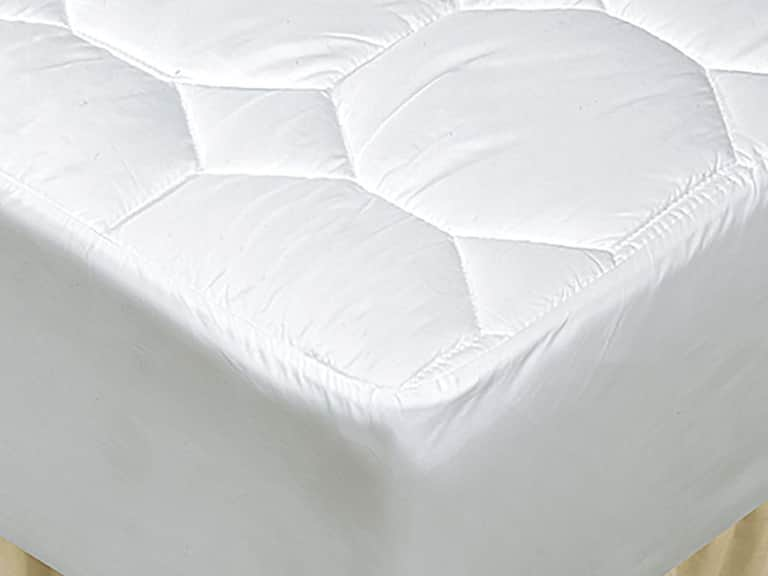
Another Naturepedic crib option is described as a quilted pad made with organic cotton inside and out, with two-inch quilted squares and a percale cover. Its listed dimensions include an eight-inch depth, and the product information specifies a crib size of 28 by 52 inches. These details point to a different construction and fitting profile from a flat moisture pad. Read each listing carefully rather than assuming that products from the same brand use interchangeable designs.
Fit is a safety and usability detail
A well-fitting crib pad should lie smoothly and remain in place beneath the fitted sheet. Look for corners or edges designed for the mattress style, and confirm that the product is intended for use with the mattress you have. For a fitted pad, the elastic or skirt should secure around the mattress without needing forceful stretching. A flat pad should be used only in the manner specified by its manufacturer and must not be allowed to shift or bunch.
Once fitted, inspect the entire surface. The pad should not curl at the corners, sag along the sides, or create ridges beneath the sheet. The sheet itself should also fit snugly. If a pad is difficult to install, pulls loose, or leaves excess fabric, stop and reassess whether its size and construction are appropriate. Do not try to correct a poor fit with clips, pins, extra layers, or improvised fasteners.
Wash and dry a new pad according to its label before use if the manufacturer recommends it. Some cotton products may change slightly after laundering; others are pre-shrunk or designed with a specific allowance. After washing, check that it still lies flat and fits as intended. Regular checks are especially sensible after laundering, after a change of mattress, or when the product shows signs of wear.
Cotton, quilting, and the feel of the surface
Cotton is widely used in bedding because it can be woven into a range of textures and weights. Percale is typically a crisp, plain-weave fabric; flannel is brushed for a softer, warmer hand; jersey is knitted and tends to stretch. The words describe fabric structures and finishes, not a promise about how a particular baby will sleep or how a product will perform in every room.
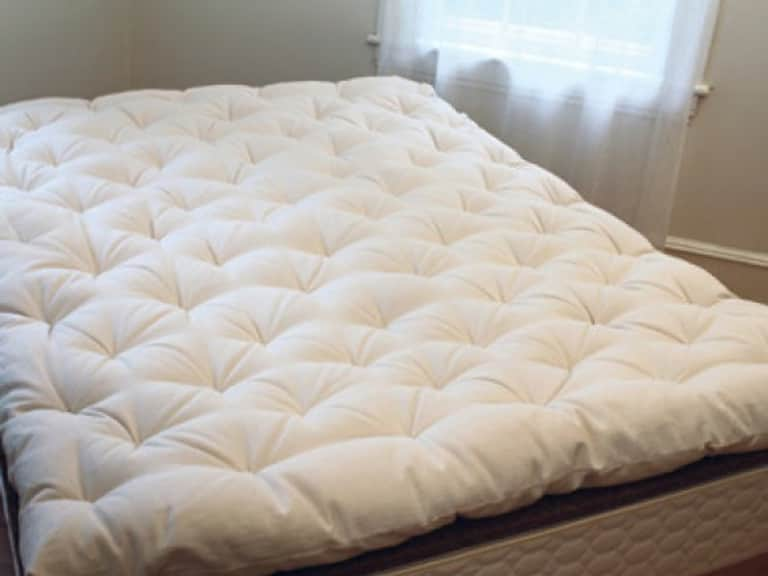
Quilting joins layers and helps keep fill from shifting. A square or channel pattern can create a softly cushioned feel, while a flatter pad with a thin internal barrier may add little loft. More padding is not automatically better in a crib. The purpose is to use a product specifically intended for the mattress and to maintain the firm, flat sleep surface described by the relevant safety guidance.
“Organic cotton” refers to the way the cotton is grown and processed under a particular certification or standard. It does not, by itself, describe the complete product, establish that every component is organic, or guarantee a specific health outcome. If certification matters to your decision, check what is certified, who issued the certification, and whether it applies to the finished item or only to certain materials. Product labels and certification directories are more useful than an unqualified marketing phrase.
Construction details also deserve attention. A pad may contain cotton batting, a cotton cover, elastic, stitching, and—if it is waterproof—a separate membrane. Each component affects feel, flexibility, care, and fit. A product’s material list can help you understand what is present, but it cannot substitute for following the mattress and crib instructions.
Waterproof layers: useful function, different feel
A waterproof layer can help prevent liquid from reaching the mattress. That can be useful when a nursery routine includes frequent spills or other moisture. In the Naturepedic flat waterproof example, a thin inner layer is enclosed between cotton outer layers. This creates a different kind of pad from an all-cotton quilted model, even though both are described as organic cotton bedding.
Waterproofing may affect how a pad feels, folds, or dries. A thin membrane is not the same as a thick, padded protector, and the term “waterproof” does not tell you whether the surface is quiet, breathable, or suitable for a particular mattress. Check the complete product description and care label. If your priority is a particular surface feel or a specific degree of protection, compare the stated construction rather than relying on a single adjective.
It is also worth being precise about what a moisture barrier does not do. It does not replace appropriate mattress care, correct sheet fit, or safe-sleep practices. Nor does a product’s material description establish that it prevents allergies, illness, or sleep disruption. Those are separate questions that should be addressed with reliable, relevant sources.
Care instructions for everyday use
A crib pad is most useful when its care routine is realistic. Some products are machine washable; others require particular temperatures, gentle cycles, low-heat drying, or professional cleaning. A waterproof layer may have different care limits from the cotton fabric around it. Follow the product’s label rather than applying a general rule to every pad.
For washable cotton pads, the manufacturer may recommend cold or warm water, a gentle cycle, mild detergent, and low heat. Avoid bleach or fabric softener when the instructions advise against them. Excessive heat can affect elastic, seams, or a waterproof component, while unsuitable detergents may leave residues or alter fabric performance. If an item is not machine washable, do not assume that a home wash is harmless.
- Read the care label before the first wash and keep it available for reference.
- Use the stated cycle and temperature; do not exceed the recommended dryer heat.
- Inspect seams, elastic, quilting, and any waterproof backing after laundering.
- Allow the pad to dry completely before placing it back on the mattress.
- Replace it if it develops holes, loose threads, damaged elastic, a peeling barrier, or persistent distortion.
For a pad that needs frequent washing, ease of care may matter more than an elaborate surface finish. Consider whether you can follow the instructions consistently and whether you have a practical backup plan during laundry. Keeping spare fitted sheets is often more straightforward than adding layers to the sleep surface; any additional bedding should still follow the crib and mattress manufacturers’ directions and applicable safe-sleep guidance.
How to compare product descriptions
Retail copy can be polished, but the most useful details are concrete. Look for a materials list, exact dimensions, mattress-depth information, construction notes, laundering instructions, and any relevant certification. If one of these points is missing, consult the manufacturer’s current documentation or ask the seller for clarification before buying.
| Detail | What to verify | Why it matters |
|---|---|---|
| Dimensions | Length, width, and intended mattress type | Helps avoid loose edges or a difficult fit |
| Depth and attachment | Maximum mattress thickness, fitted skirt, elastic, or flat format | Clarifies how the pad is designed to stay in place |
| Materials | Cover, fill, backing, and other components | Shows what the product is actually made from |
| Waterproofing | Whether a barrier is included and where it sits | Distinguishes moisture protection from simple cushioning |
| Care | Wash cycle, temperature, drying method, and restrictions | Supports routine cleaning without damaging construction |
| Certification | Certifier, scope, and product or material covered | Gives context to organic or other standards claims |
A measured approach to organic claims
For many families, organic materials are one consideration among several: fit, maintenance, texture, budget, and the product’s intended use all matter. It is reasonable to prefer a clearly documented material, but a label should not be treated as shorthand for “safer in every respect” or “better sleep.” The details of the finished product, its fit, and how it is used remain important.
When a product description mentions a certification, look for the name of the standard and what it covers. A certification may apply to fiber production, processing, or the finished textile, depending on the program. Confirm the claim with the certifier’s own materials when possible. If a label uses broad language without identifying a standard, ask for specifics rather than trying to infer them.
Material sensitivity is individual. If a baby has a diagnosed allergy, skin condition, or other medical concern, discuss suitable bedding with a qualified healthcare professional. A product’s “natural,” “organic,” or “hypoallergenic” wording does not establish that it is appropriate for every child.
A simple buying checklist
Before settling on a crib mattress pad, use this short sequence to keep the decision practical:
- Identify the crib mattress make, size, and depth.
- Choose the function you need: a quilted protective layer, a moisture barrier, or a product designed to combine both.
- Read the material and construction details, including any fill and waterproof components.
- Check that the pad is explicitly intended for the mattress type and that its dimensions match.
- Review current care instructions and decide whether they fit your household routine.
- Confirm that the pad and fitted sheet lie smooth and secure, following manufacturer and safe-sleep guidance.
- Recheck fit and condition after washing and throughout use.
The bottom line
The best organic crib mattress pad is not necessarily the one with the most features. It is the one whose dimensions suit the mattress, whose construction matches your practical needs, whose care instructions you can follow, and whose fit remains secure and smooth. Cotton fabric, quilting, and a waterproof layer each contribute different qualities; none should be judged in isolation.
Naturepedic’s described crib options show how these choices can vary: a flat moisture pad with cotton layers and a thin waterproof inner barrier serves a different purpose and has a different profile from a quilted cotton pad. Use those specifications as a starting point for comparison, then verify current product details and follow the crib, mattress, and health-safety guidance that applies to your family. In nursery bedding, considered simplicity is often the most useful design principle: clear materials, dependable fit, straightforward care, and no unnecessary layers.